Professional designer and manufacture of CCD machines for ONE STOP SOLUTION.
Language
Professional designer and manufacture of CCD machines for ONE STOP SOLUTION.
With the introduction of the iPhone 4, the mobile phone was once again redefined. It also marks the evolution of mobile phones from feature phones to smart phones, and the size of mobile phones has gone through a process of changing from small to large along with the screen size. From the size of mahjong, to 5 inches and 5.5 inches, to the current large screen of more than 6 inches, the frame of mobile phones is also becoming thinner and thinner to meet consumer demand.

Black borders are ubiquitous in mobile phones. The scientific name of black borders is called BM area. The primary function is to prevent light leakage from the screen. If there is no such BM area on a screen, you will see obvious halos on the edge of the screen. Because each mobile phone will have some errors when assembling the screen, it is impossible to achieve absolute alignment.
If the outer frame of the screen is aligned with the visible edge of the BM area, a colored glare will appear on the edge of the frame. The white frame of the mobile phone may reflect the screen light, and bright edges will appear around the screen. And now some mobile phone screens have obvious light leakage phenomenon, because the error of the screen assembly is relatively large.
In addition to the problems in the BM area, there are also the problems of structure and cost. Needless to say, the cost problem is that special screens need to be customized separately, and the cost will not be cheaper than that of the male model; in addition, the drop resistance of the mobile phone screen is not It is not completely protected by glass. Usually, the side surface is in contact with hard objects. At this time, the frame can play a certain protective role. This is why mobile phone products reserve a certain width of the frame. drop strength.
The big black borders of mobile phone screens are something we have always been tired of, and the visual gap caused by them has always been controversial. In fact, today we can not only see the black borders of mobile phones continue to shrink, with the development of technology , the narrow border technology came into being.
The ultimate narrow frame brings consumers a better visual experience and a better grip. However, due to the complex test of the process, the narrow frame requires the manufacturer to have a long accumulation in technology, so the narrow frame has become one of the labels of the manufacturer's own strong strength.
Asynchronous die-cutting process after CCD visual silk screen printing of ultra-fine borders
Grab specific marks on the material through the CCD vision system, such as round hole knife mark (may not be punched through), square hole knife mark, or printed dots, squares, crosses, etc. Capture images for comparison, adjust the material in three directions of X/Y/Z, when the center point of the marked image is completely coincident with the center point of the CCD system, send an instruction to the die-cutting machine for punching. Every punch, every alignment, with no cumulative tolerance.
CCD vision nesting die-cutting is mainly used in the following products: die-cutting after keyboard silk-screen printing, die-cutting after diffusion silk-screen printing, die-cutting after printing, and die-cutting products with high precision requirements.
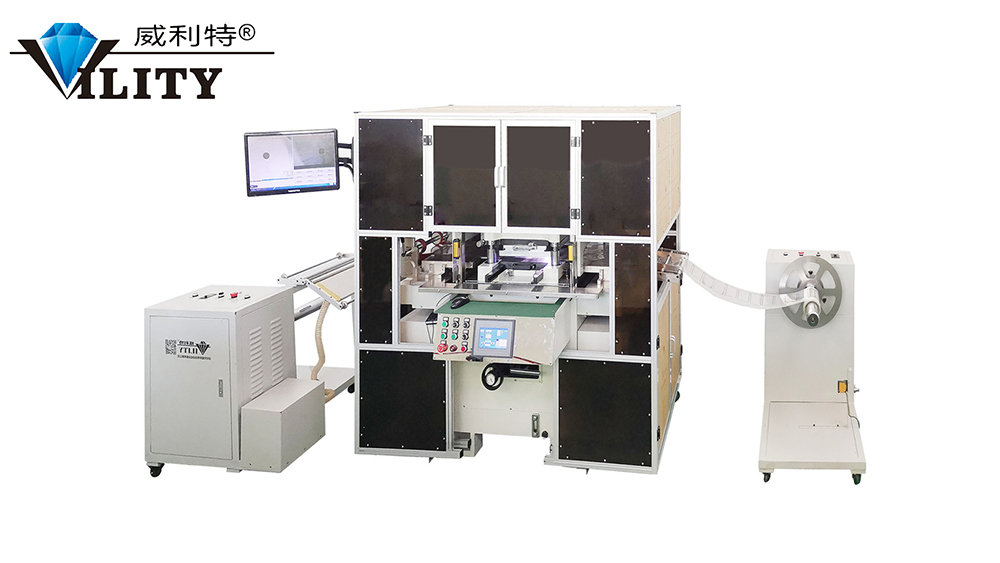
This time, we will mainly show you an asynchronous die-cutting process after CCD visual silk screen printing with ultra-fine borders:
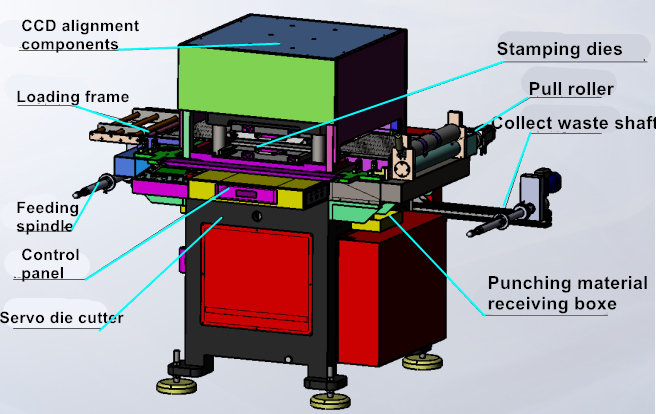
The unwinding machine unwinds the screen-printed die-cut adhesive tape products. After entering the CCD vision, the asynchronous die-cutting machine performs positioning and die-cutting. The equipment supports the CCD camera and lens. System analysis, when the product is blocked, the system alarms and stops, and the Ensure that defective products do not flow into the next process and improve yield.
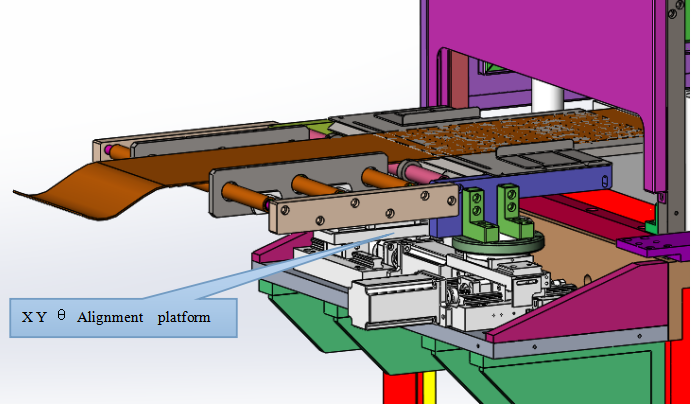
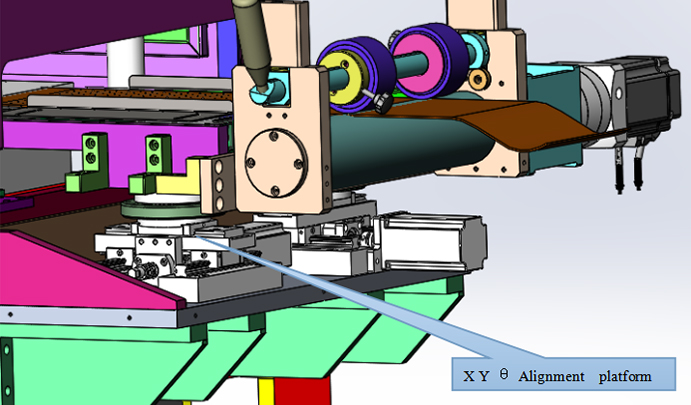
Then, the post-asynchronous pulling and punching is performed. This step also supports the CCD camera and lens, and the system analyzes. When the product hole position deviates, the system alarms and stops to ensure that the defective products are not punched and the yield rate is improved.
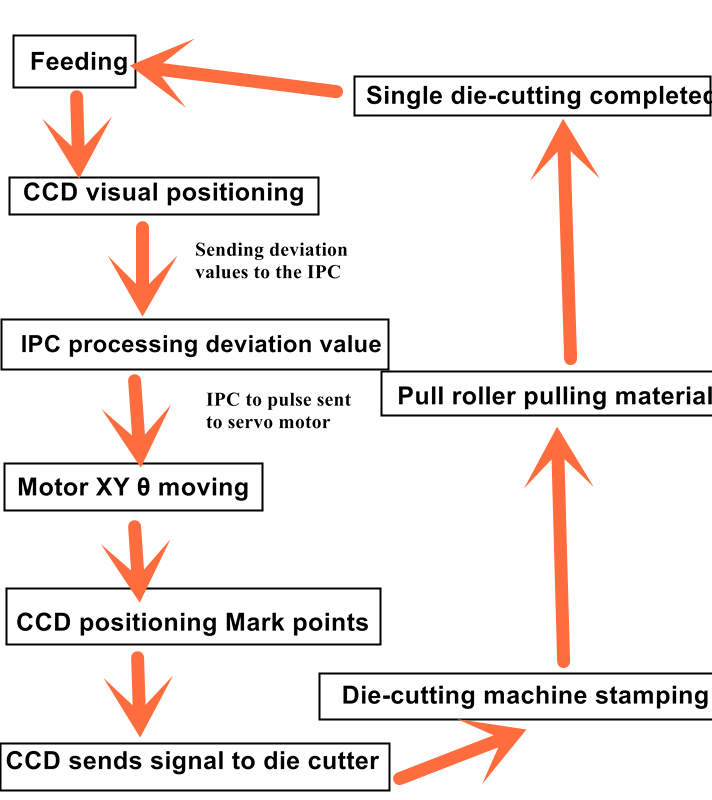
Finally, the die-cut product enters the three-station laminating machine for waste discharge, and the waste of the outer frame is eliminated.
CCD post-asynchronous die-cutting machine solves the problem of material saving in the process of die-cutting process in the form of T-cross. The punching accuracy can reach ±0.03mm, and the punching can be compensated according to the margin of the printed product, so that the poor printed diffusion product can be corrected and punched, so that the bad product can be changed from waste to good material, and the change from fee to treasure, Strictly control the occurrence of defective products.
Vility screen printing will continue
Focus on intelligent automation
Development and manufacture of screen printing equipment
Provide global customers
Intelligent automation full set of screen printing equipment
And screen printing overall solution
Create an international well-known brand of screen printing intelligent manufacturing equipment
Vility screen printing, leading to the world

VILITY is a Professional manufacturer, providing ONE-STOP SOLUTION for intelligent printing industry.

